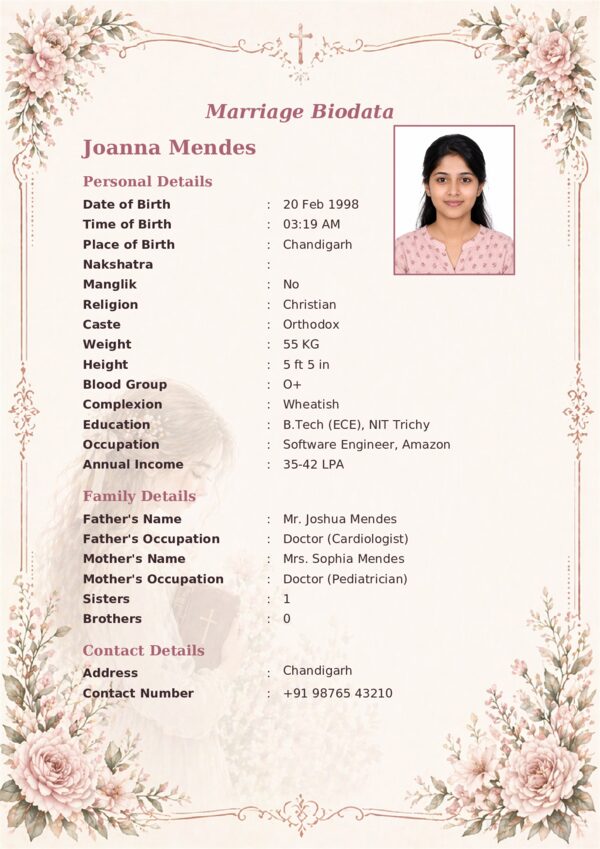
Personal Details
Full name (with Christian name and family name), date and place of birth, height, weight, complexion, blood group. Mention baptism status if relevant to your community.
A Christian marriage biodata follows the same broad structure as any marriage profile, with a few Christian-specific fields: denomination (Catholic, Protestant, Pentecostal, Orthodox, Syrian), parish, church attendance, and family background. Most Christian families value education, profession, and personal character over caste or astrology. The templates below use Christian design elements — cross, dove, chalice, soft pastels and white backgrounds — appropriate for Christian families across India and the diaspora.
Each template is free to download as PDF. Click any preview to start filling your details.
Full name (with Christian name and family name), date and place of birth, height, weight, complexion, blood group. Mention baptism status if relevant to your community.
Roman Catholic, CSI, CNI, Pentecostal, Syrian Orthodox, Marthoma, Jacobite, etc. Include parish or home church if applicable. This is the first thing most Christian families check for compatibility.
Parents' names and occupations, siblings, native place. If you're from Kerala (Syrian Christian) or Goa (Catholic), include the ancestral home/village — it carries weight in those communities.
Highest qualification, current job role, company, annual income, work location. Christian families tend to emphasise education and career — be specific.
Frequency of church attendance, involvement in church groups, Sunday school teacher, choir, etc. These are gentle indicators of how devout the family is.
Denomination preference, age range, education, profession, location. Three to four lines — over-specifying narrows the pool.
Pick the Christian template above, click it, fill in your details (name, DOB, denomination, parish, education, family, photo), and click Download. The PDF is ready in about a minute. No signup or payment.
Christian biodatas include denomination, parish, church involvement and use Christian design motifs (cross, dove, chalice). They typically don't include caste, gotra, manglik, or nakshatra fields. The personal, family, education, and profession sections are similar to other matrimony biodatas.
Yes — denomination is one of the first things Christian families check, since worship styles, theological emphasis, and traditions vary significantly between Catholic, Pentecostal, Syrian Orthodox, etc. Including it upfront avoids mismatched introductions later.
Yes — the design and structure are general enough to work for any Christian denomination. The template doesn't hardcode any denomination-specific imagery; you fill in your own denomination in the field.
Download the PDF, then use the one-tap WhatsApp share button on the success page. The PDF is small and sends directly. You can also email it as an attachment or share as a JPG image.
Generally no — Christian theology doesn't emphasize astrology, so most biodatas skip the nakshatra/manglik fields you'd find in Hindu biodatas. Some Indian Christian families in regions with strong cultural blending may still include date and time of birth, but it's not mandatory.
Pick a template, fill your details, download as PDF. Completely free.
Choose a template →