Personal Details
Full name, date and place of birth, height, weight, complexion, marital status (never married / divorced / widowed). Disclose honestly — first impressions matter.
A Muslim marriage biodata (or rishta biodata) carries information that helps families assess compatibility for nikah — sect (Sunni/Shia), masjid attendance or namaz frequency, family background, and the usual personal and educational details. Whether you call it a shaadi biodata, nikah profile, or matrimonial CV, the structure is the same. The templates below use Islamic design motifs — mosque silhouettes, crescent moon, geometric patterns, Bismillah headers — and include the fields Muslim families specifically look for.
Each template is free to download as PDF. Click any preview to start filling your details.
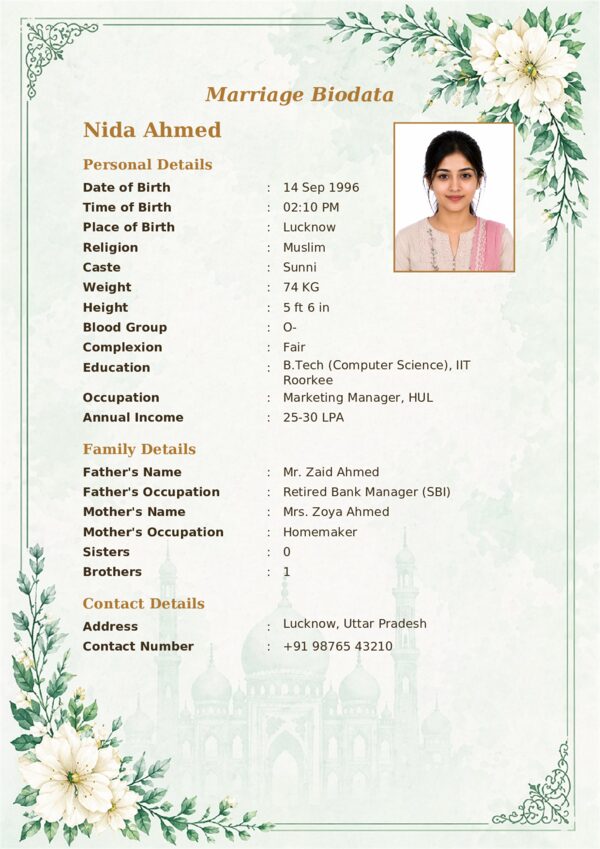
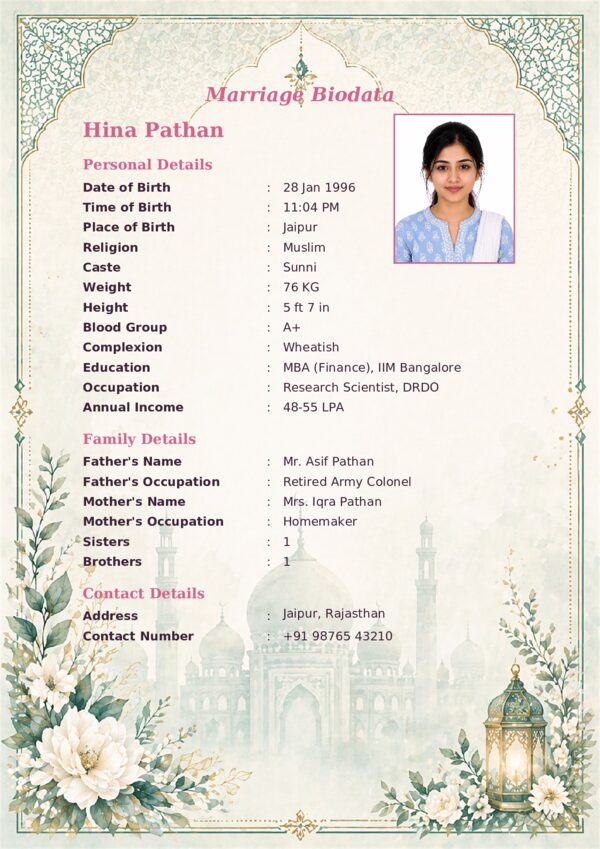
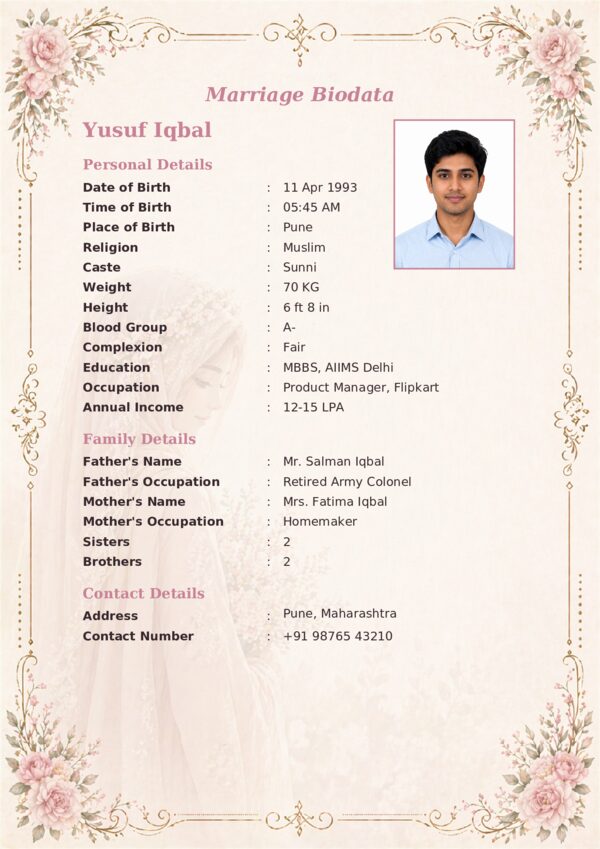
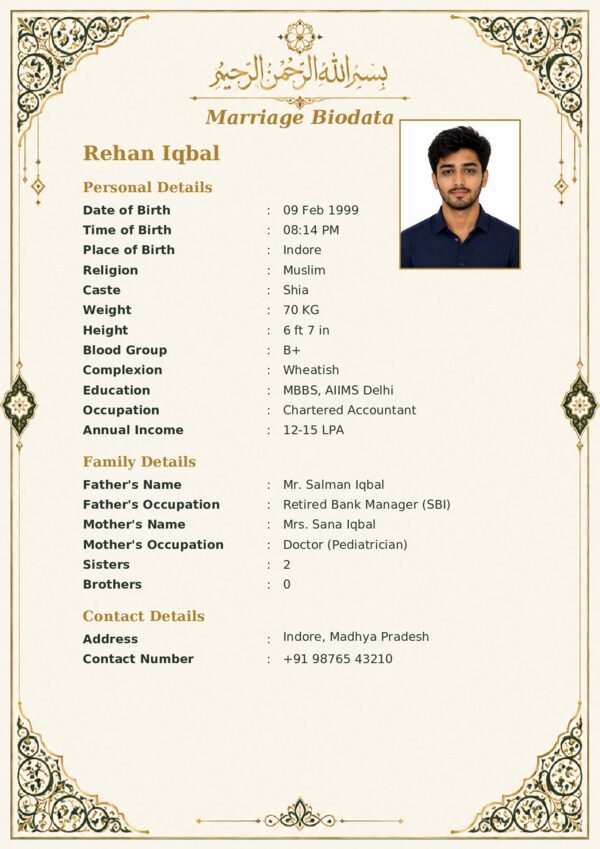
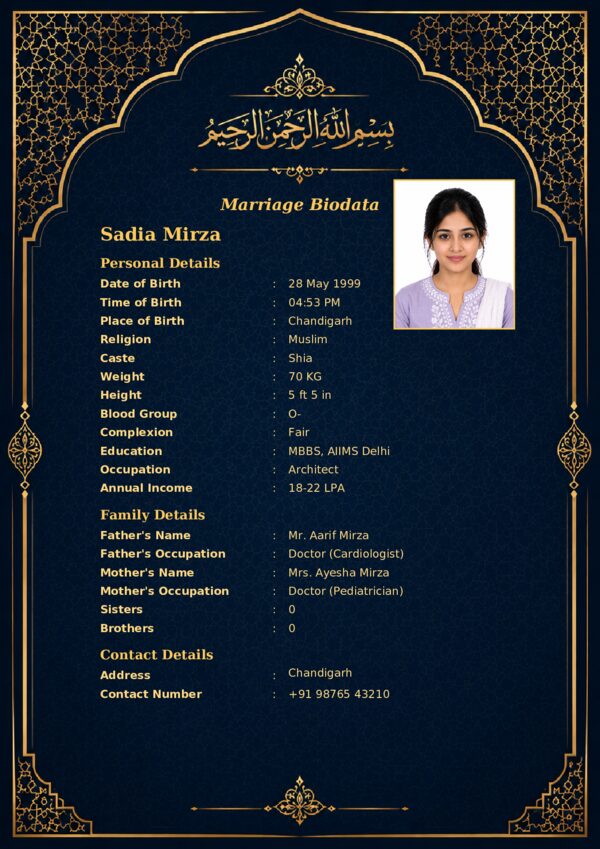
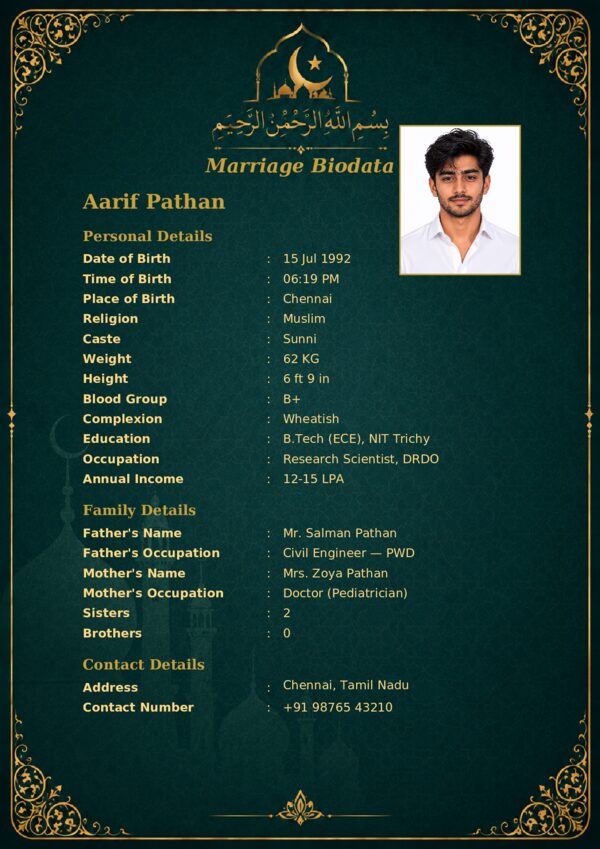
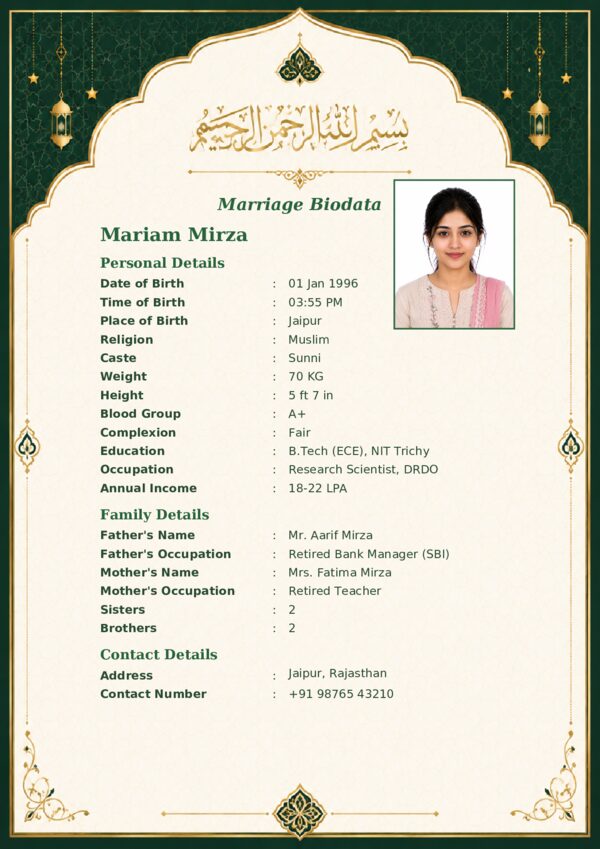
Full name, date and place of birth, height, weight, complexion, marital status (never married / divorced / widowed). Disclose honestly — first impressions matter.
Sunni or Shia, sub-sect if relevant (Hanafi, Shafi'i, Ja'fari, etc.), namaz frequency, whether you observe purdah / hijab. These are the first questions most Muslim families ask, so include them upfront.
Father's and mother's names and occupations, siblings, native place, and family religious practice. Many Muslim families also note biraderi / community (Pathan, Sayyid, Shaikh, Ansari, etc.) if it matters in their region.
Educational qualifications and current profession with income range. For girls, families often note whether you'll continue working after marriage — be clear about your intentions to avoid mismatch later.
Sect preference, age range, education, profession, and any specific requirements (e.g., practising namazi, willing to relocate). Two to four lines — over-specifying limits the pool.
Phone, email, address. A clear photo (with or without hijab, depending on preference) significantly improves response rates. Our maker auto-resizes the photo to fit any template you pick.
Pick any template above, click it, fill in your details (name, DOB, sect, family info, education, photo) and click Download. You'll get a watermark-free PDF in under a minute. No signup or payment required.
In addition to personal details (name, DOB, height, weight, complexion), Muslim biodatas typically include sect (Sunni/Shia), namaz frequency, family religious practice, biraderi/community, education, profession, family details, partner preferences, and contact information. All our Muslim templates include these fields by default.
English is most common because it works across India, Pakistan, Bangladesh, and the Middle East. Urdu biodatas are still preferred in some traditional families. Our biodata maker supports both Urdu (right-to-left layout) and English — switch using the language dropdown in the form header.
It depends on the family. Most modern Muslim families include a photo — and our templates support photo upload. If you prefer a no-photo version (some Salafi or strictly conservative families), simply leave the photo field empty and the template adjusts the layout automatically.
After downloading the PDF, the success page gives you a one-tap WhatsApp share button. The PDF is around 200–500 KB and sends directly without compression. You can also share as an image (Download as Image button on the same page).
Yes. The structure works for Muslim families anywhere — the field names (sect, biraderi, namaz, education, profession) are universal. We have Sunni and Shia families from Pakistan, Bangladesh, Saudi Arabia, UAE, and the UK using these templates.
Hindu biodatas focus on gotra, nakshatra, manglik and family astrology, with Hindu visual motifs (Om, mandala, Ganesh). Muslim biodatas focus on sect, biraderi, namaz frequency with Islamic visual motifs (crescent, mosque silhouette, Bismillah). The personal-info fields (name, DOB, education, family) are common to both.
Pick a template, fill your details, download as PDF. Completely free.
Choose a template →