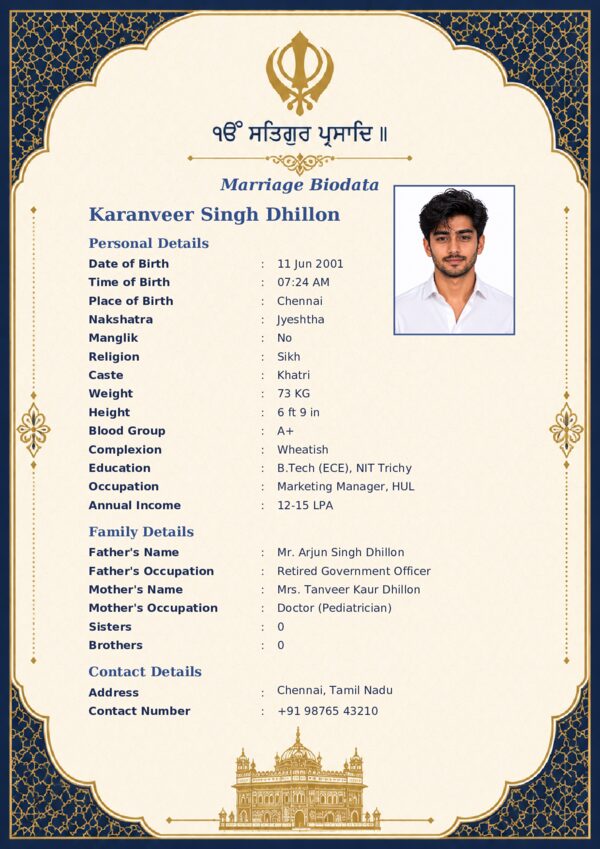
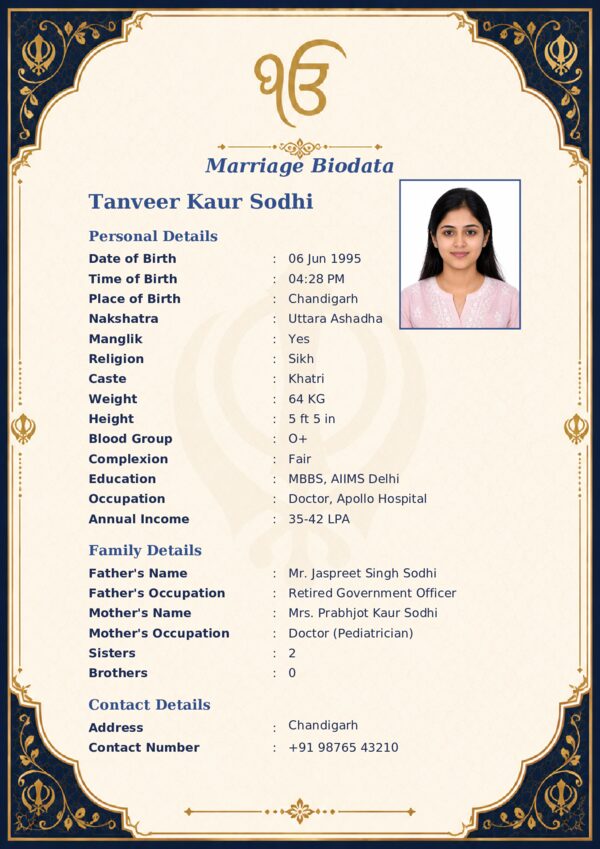
Personal Details
Full name (with Singh / Kaur surname or family name), date and place of birth, height, weight, complexion, blood group. Mention amritdhari status if applicable — many Sikh families specifically look for this.
A Sikh marriage biodata for anand karaj or rishta exchange includes the personal, professional, and family information common to all marriage profiles — plus a few Sikh-specific fields: gotra, amritdhari status, beard (kesh) maintenance, and family village in Punjab. The templates below use Sikh design elements like the Khanda, Ik Onkar, Golden Temple silhouette, and traditional Punjabi colour palettes (deep maroon, saffron, gold). All templates work for both single-name (Singh / Kaur) and double-name conventions.
Each template is free to download as PDF. Click any preview to start filling your details.
Full name (with Singh / Kaur surname or family name), date and place of birth, height, weight, complexion, blood group. Mention amritdhari status if applicable — many Sikh families specifically look for this.
Gotra, native village/district in Punjab (even if you've never lived there), father's and mother's names and occupations, siblings. Sikh marriage often involves checking gotra alignment (same gotra is avoided) so this matters.
Highest qualification, current job role, company, annual income, work location. Punjabi diaspora families (UK, Canada, Australia) usually also note country of residence and visa/PR status.
Gurudwara attendance, observance of the 5 Ks (kesh, kanga, kara, kachera, kirpan), language spoken at home (Punjabi/Hindi/English). These are gentle indicators of how traditional the family is.
Age range, height, education, profession, location, and any cultural preferences (e.g., amritdhari preferred, willing to relocate to Canada/UK). Two to four lines max.
Phone, email, current address. Photo with turban (for men) is typical; a clear front-facing portrait works best. Our biodata maker auto-resizes the photo to fit any template.
Pick any of the Sikh templates above, click it, fill in your details (name, gotra, native village, education, family, photo) and download as a PDF. No signup needed. Completely free with no watermark.
A typical Sikh marriage biodata is one page and includes: personal details (name, DOB, height, weight, amritdhari status), family details (gotra, native village/district in Punjab, parents, siblings), education and profession, partner preferences, and contact information. Most Sikh biodatas also include a photo and Khanda or Ik Onkar header.
Gotra in Sikh marriages works similarly to Hindu tradition — families avoid matching same-gotra individuals to prevent close-relative unions. Many Sikh templates have a dedicated gotra field. If your family doesn't emphasize gotra, you can leave it blank.
English is the most universal — works for families in India, Canada, UK, US, Australia. Punjabi (Gurmukhi script) is preferred by some traditional families in Punjab. Our biodata maker supports both — switch the language using the dropdown in the form header.
Absolutely. Most Sikh families today have non-amritdhari members. Simply leave the amritdhari field as "No" or skip it. The templates auto-adjust to hide empty fields, so your biodata stays clean.
Download the PDF and share via WhatsApp using the one-tap WhatsApp share button on the success page. Most rishta-walas, matrimony brokers, and gurudwara committees prefer PDFs. You can also save as image for Instagram or Facebook DMs.
They're structurally similar (both include gotra and family details), but Sikh biodatas typically skip nakshatra, manglik, and astrological fields since Sikhism doesn't emphasize astrology. Visual design uses Sikh symbols (Khanda, Ik Onkar, Golden Temple) instead of Hindu motifs (Om, Ganesh, mandala).
Pick a template, fill your details, download as PDF. Completely free.
Choose a template →